
15 Sept 2026 · 5 min read
How to prioritise research for product innovation

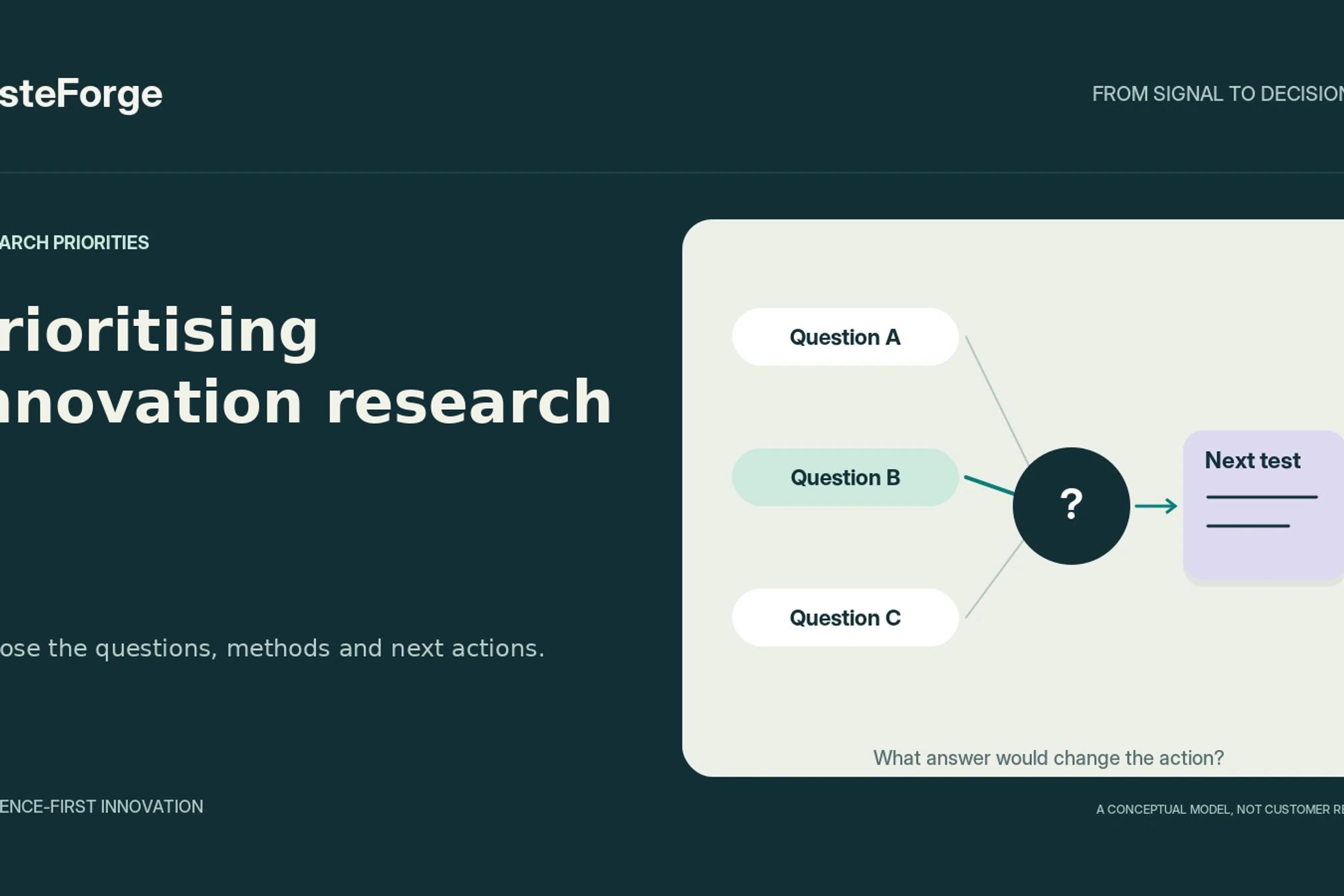
Choose research that resolves important uncertainties within the time and budget available.
Research prioritisation means choosing which uncertainty to investigate first, given the decisions, budget and time available. A team may need to understand the consumer occasion, test a price assumption, assess competitors or check production feasibility.
Consider a hypothetical project with funding for one more piece of work before its next review. The most useful choice depends on which possible finding could change the development plan and which questions must be resolved before the others are worth pursuing.
The approach below connects research questions to alternatives, methods and next actions. It provides a basis for discussing priorities across insight, innovation and commercial teams.
Define the choices the research will inform
Write down the options still available. The team might proceed with a small test, change the proposition, defer the concept or stop investing in it.
Then identify what separates those options. If production feasibility is unresolved and would rule out the current concept, another broad report on market interest may not help choose between them.
This does not mean that only immediate decisions deserve research. A business can investigate emerging needs before it has a specific concept. In that case, name the broader decision: which spaces should enter the opportunity pipeline, or which assumptions about the category deserve revision?
The discipline is the same. Explain the purpose of the investigation before choosing the source or method.
Assess how possible findings would change the next action
A useful test of a research brief is to complete two sentences.
"If we observe this result, we will take this action."
"If we observe the opposite result, we will do something different."
If both lead to the same action, ask whether the research is necessary now. It may serve another legitimate purpose, such as satisfying a requirement or improving understanding, but it should not be described as resolving the decision.
A third outcome also matters: the result may remain inconclusive. Decide how the team will respond to that possibility rather than treating ambiguity as permission to select the preferred interpretation.
This encourages a better question than "what data can we collect?" It asks what observation could genuinely distinguish the alternatives.
Choose a research method for each uncertainty
Different uncertainties need different kinds of work.
A supplier conversation may resolve the conditions of a quotation. A production trial may reveal whether a formulation meets a specified technical requirement. Exploratory interviews may clarify how consumers describe a problem. A suitably designed commercial test may inform a more specific claim about behaviour.
One should not be treated as a shortcut to another. Interest in a concept does not establish repeat purchasing. An expert's confidence in a process does not replace the test needed for the intended conditions.
The method should also be proportionate. A small, reversible commitment may justify a limited check. A larger, difficult-to-reverse decision may require stronger evidence and more careful evaluation.
Map assumptions to research tasks and decisions
The following is an illustrative planning tool, not a quantified research-ROI model.
Unresolved assumption: The intended process can deliver the specification
How it could change the decision: The current concept may be infeasible
Useful next work: A scoped technical trial
Result that would matter: The agreed technical requirement is met or not met.
Unresolved assumption: The proposed price makes sense to the intended shopper
How it could change the decision: The offer may need a different pack or position
Useful next work: Research on the actual proposition and alternatives
Result that would matter: A finding relevant to the specific price question.
Unresolved assumption: An apparent assortment gap represents unmet demand
How it could change the decision: The opportunity may need reframing
Useful next work: Consumer investigation and a more complete product audit
Result that would matter: Evidence supporting or challenging the need.
Unresolved assumption: A source still describes the current market
How it could change the decision: The brief may rely on a changed condition
Useful next work: Refresh the material source
Result that would matter: A change large enough to alter the assessment.
For each row, add an owner, an estimated effort and the next review date. Use judgement rather than a decorative formula to prioritise the first round.
Compare research cost, delay and decision risk
Research has a direct cost, and waiting for it can have a cost. Acting without it can also have a cost.
A useful discussion considers all three. Could the investigation arrive after the decision window? Could a smaller check answer the immediate question? Would committing now expose the business to an avoidable, difficult-to-reverse problem?
Do not manufacture precision where the inputs are uncertain. A qualitative comparison can be more honest than a calculated value built from invented probabilities and loss estimates.
The purpose is to make the trade-off explicit. "We will not research this" should be a reasoned allocation decision, not an accidental omission.
Deciding when there is enough evidence to proceed
A research task can expand indefinitely when its purpose is simply to understand a topic.
Specify what would make the current evidence sufficient for the decision. Also state what would trigger further investigation: conflicting observations, a material change in conditions or a result outside the scope of the original method.
Preserve findings that challenge the preferred concept. They may change the action even when they do not make a compelling presentation headline.
When the work is finished, assess whether it resolved the intended uncertainty. That review can improve future research briefs even when the concept does not proceed.
Connect ongoing research to active innovation projects
A continuous research function needs more than a schedule and a list of keywords.
We believe it should connect active questions, fragile assumptions and changing evidence to the people making decisions. Some work can be automated. Some needs domain expertise, primary research or direct operational checks.
At TasteForge, that is the direction linking research orchestration to innovation decision support. The relevant question is not how many sources the engine has processed. It is whether the next important question has become better answerable.
Before approving the next research task, ask the team to name one plausible finding that would change what it does next.
This article presents an original prioritisation method and hypothetical examples. It does not claim measured research savings or guaranteed commercial results.